
Jul
When people speak about spiritual origins, the landscapes are often remarkably similar: warm oceans, palm trees, turquoise water, and ancient temples bathed in golden light. And I must admit, it is beautiful. It is just that… it has never felt like home to me.
So I quietly assumed the fault must somehow be mine. Surely everyone else couldn’t be wrong. If so many people recognised themselves in stories of Lemuria, Atlantis, or distant tropical paradises, perhaps I simply wasn’t looking hard enough.
Yet every time I tried, my imagination wandered elsewhere.
North.
Towards snow, stone, silence, and stars that had always felt familiar in a way I could never quite explain.
As an academic, I have never been particularly interested in trying to decide whose spiritual experiences are more valid or more true. They belong to the people who have them. (I have often joked that I am the world’s worst theologian.) To me, questions of soul origins belong firmly in that realm of personal belief and experience. And yet, I could not stop asking one rather confused question.
Why did nobody ever seem to wonder whether souls could remember the North?
Even Hyperborea, so often associated with the North in the academic world, somehow seemed to acquire turquoise waters the moment it entered popular spirituality.
One evening, mildly irritated and more than a little amused with myself, I sat down to write. I had no idea that those few pages would quietly change the direction of my life.
I am struggling with sandals. There’s snow outside, and it’s cold, and dark, and all I can see is the luminous sparkle of eternity in the sky. And I wonder what is wrong with me, because I cannot find my spiritual home in turquoise waters and hibiscus light, like – so it seems – everyone else. And I feel so alone in my silent diaspora, lost in thought, lost in spirit, staring at the imaginary pair of sandals.
There is no use for sandals up here, in the far, far north, where the earth meets the sky. In my soul, I carry strong wind, never-yielding stone, the caress of snowflakes, and the pillar that holds the universe in place. Yet I am told to find a soul home somewhere else. But how could I? I already have one.
It is in the stillness where Vega still hums in every wind, where Polaris still shines upon every darkness, where Thuban still breathes, where the Swan still guards, and where everything began.
It’s beautiful in a silent, dignified way that demands nothing. It simply is – rooted in quiet immensity. It’s the ancestral silence behind the world’s myths. It is the place of ancient stone that holds the memory of the planet beginning to dream. It is the pillar around which all worlds rotate. It is a realm, a state of being, a boundary, and a beyond. Without it, the world spins blind.
It is a memory of the sky itself descending, the Arctic temple of the first dawn, the realm where the Earth’s deepest magic resides, the axis around which the world herself turns. It exists on no earthly maps, yet it exists on the edge of every transformation.
It’s the first threshold, a cosmological True North. It’s the Otherworld. It is the place before stories began. It’s my home. And it is called Pohjola.
“It’s the forgotten ones.”
I hear a whisper, steady like eternity, crystal-clear like the sky on a frost-filled night.
“You breathe memories older than time. You are not alone. There are others who will remember Pohjola. Tell them, so they may remember.”
I sit in stillness for a long, timeless breath. I know the myths I carry are memories of Pohjola; at least, that is how it feels. But are there others? That thought has never crossed my mind. Ever. Could it be true that I am not the only one feeling misplaced, dismissed, forgotten? Yet what I am told suggests something more, and as much as I want to believe it, I cannot. I simply cannot believe there could be a whole forgotten old soul-line out there. One that held the world axis long before civilizations rose. Could it be true? Could it not?
My head spins. My academic mind opens files, maps, catalogues, lists, footnotes, combing through Mesopotamian sky maps and creation stories, Egyptian weights of the soul and meticulous architecture, Pohjola’s cosmological pillars and soul-routes. Meanwhile, my body, heart, and soul feel grace, wonder, and a strange relief.
This, they say, this we can relate to.
I smile weakly. This is so typical of me. I have never been able to squeeze myself into a box – not one. But this is… next level. Do I really have to feel the one origin that is not spoken of?
Just because something is different does not mean it cannot exist. I am reminded of this often. When I look in the mirror. By the same reasoning, one could, perhaps, think that just because something is different does not mean it cannot be a place where souls begin.
I close my too active brain for a moment and let the feeling flow through me and… be.
I know how it feels to be from the Otherworld. It is lonely sometimes, and cold, sombre, and heavy. How could it not be? It is the realm that holds sky and earth in place.
But that is the point. In a world that seeks light and soothing warmth, Pohjola is dark and eerie, lit only by stars; that luminescent presence of forever and beyond. I cannot place it beside Lemuria or Atlantis, even if I tried. There is no use for sandals in Pohjola, I reason – to… Whomever.
And I hear a laugh, sparkling, ever-present in every stardust within me:
“Are you not part of the symphony created to hold the cosmos in balance? For every lightness, a darkness is needed for a star to be born. You are needed. One pillar is missing.”
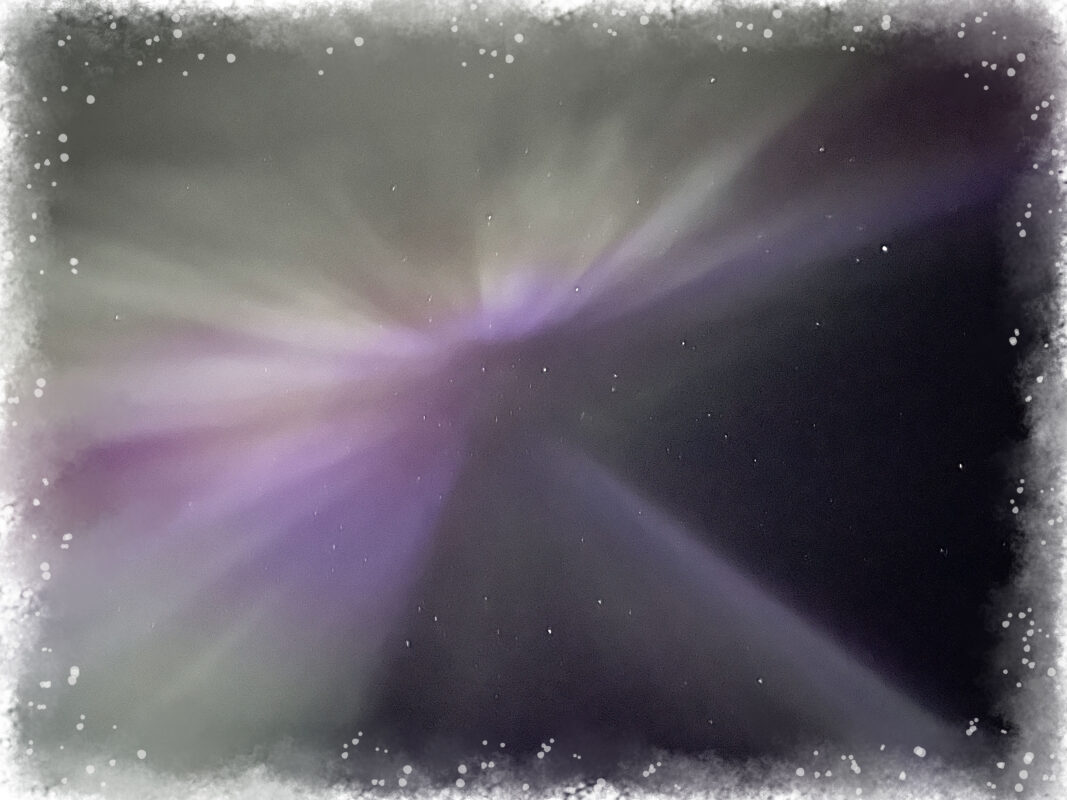
And finally, the truth reveals itself like the aurora – unapologetically silent, luminously wild, majestically raw, purifying, leaving only what is needed. The truth.
Some souls remember crystalline waters. But some souls… some souls still remember polar stars.
The realization makes me feel light, yet deeply rooted – above and below, and everything in between. I, too, am part of a cosmic symphony. By adding my own frequency, I honour every other one.
In the symphony of the Earth-stars, I hear crystalline, light tones, the sacred harmonics of Lemuria and Atlantis, and many others. I hear Saturn, Jupiter, Mars. I hear them all. Yet only one sound is my home: the low hum beneath everything, the heartbeat of the Great Mother. That is my tone. Sacred. Holding time and space. Are there others who hear it too?
Yet even if that were true… who am I to speak? And to whom? I am a lone soul in a far land, holding memories from before breath existed. No footnotes. No references. Only thousands of years of myth, magic, and truth. No glory, just raw, polar, steady, primordial truth. It’s rock, wind, aurora, ancient memory. And it is forgotten.
Except, it seems, it isn’t.
And so my academic mind takes charge. I begin research. Pretty words are not enough, this is too important. I need facts because Pohjola is more than a field. It is not only the Otherworld but also… here, and it is just as much as above, as it is so below, within and without. It’s the pillar in between.
It’s one of the oldest mythic cosmologies on Earth. And I know where to look. I have studied it my whole life. I just never knew it would one day matter.
Finnish mythic poetry is among the largest in the world. Pohjola lives in language, runo-songs, petroglyphs, constellations, and the swan that crosses worlds. Finnish/Kalevalaic cosmology is part of an ancient circumpolar shamanic world, older than agriculture, older than cities. It preserves pre–Indo-European structures, Uralic and Siberian soul-journey lore, Ice Age–era cosmology. The Kalevala was written down in the 19th century, but the cosmology beneath it may be 10,000–20,000 years old, or more.
When I hold my favourite slice of stone, I am in awe. This gneiss is billions of years old; part of the Fennoscandian bedrock, among the oldest on Earth. It once bore the weight of supercontinents. It cooled in planetary dawn. It makes me cry every time, from homesickness, gratitude, wonder. If memory can live in matter, this stone remembers everything. I love ancient libraries – Alexandria, Nineveh. But when I walk barefoot in the forest, I walk in a library older than continents.
Slowly, I begin to understand. If soul-memory lingers where Earth is oldest, the North may be one of humanity’s deepest origin points. And still I hesitate. Who would listen if I said an entire axis of soul-memory is missing; the northern one?
Yet… One pillar is missing. The forgotten ones. The voice was clear, and it was insistent. The feeling is just as insistent:
something is birthing.
Something wants to exhale – and then inhale for the first time in tens of thousands of years. I hear it calling. I feel its breath. And I realize… What people seek has always been here. It simply does not glitter.
Pohjola carries no golden-turquoise glow. Its stone-hard steadiness carries the cosmos itself. Its light comes from stars and northern fire. Its trees reach the skies. Its waters reflect the universe. It has no gods, no hierarchy, only nature and those who guard it.
Those who came before gods, and who remain after.
Pohjola is raw, imposing, silent. Capable of destruction and birth. Too true for a world chasing easy light. And I realise that this is what the Northern souls are born to do: to point to the dark light at the edge of cosmos. To Pohjola.
And the truth lands onto my hands like a lightest of snowflakes. We live in an age where the world’s axis is metaphorically shaking. Our climate, identity, cosmology, meaning, everything is unstable. And whenever the axis shakes, Pohjola stirs. And how it has stirred lately… It had returned to the collective through the revival of northern shamanic traditions, the reawakening of interest in Fennoscandian myth, the fascination with auroras and polar research, the sense that silence is becoming a spiritual resource. They might call it Hyperborea. What she calls herself, though, is older than myth.
It’s Pohjola.
And I look outside, to the falling snow, silent, still, and I think how, in a snowflake, we can still feel the vibrations and frequencies so ancient, so true, so powerful in their fragility, that we are forever wondering their grace. And I cannot but think that us Northern souls are like snowflakes. If you put us to latitudes where most origin stories are searched for, it destroys us. But put us in the North… And we create an avalanche.
Although I am sure that origin like this cannot be lost, it could very well be that we might cease knowing that we miss it. But when we stand alone under a winter sky, or feel steadied by ancient stone, or hear silence that feels like home… Pohjola opens a crack. And we might remember how the world felt when it was still learning to breathe. And we might realise that we do not find Pohjola. We recognize it. It is the quiet within us that has always known where north is. Even in the dark. We only have to look a Polaris, and we know we find home.
It bothers me, to think that maybe someone hears the call but does not recognize it, because no one has ever told them that Pohjola exists, or nobody ever told them that, darling, if you cannot feel your soul shining, it might be because it shines brightest in the dark.
And everything in me – my soul, my body, and every generation back and forth in me, and the land beneath me and all the sky above, everything within and without – demands that I speak for those who cannot. And so, I look at the polar stars, and I breathe the starlit foundations of the cosmos, and I kneel, and I press my hands to the ground to feel her steady pulse deep, deep, deep down. And I send an invitation to the wind. Not because I can. But because I have to.
Hear me, you forgotten ones. The gates are open. Welcome to Pohjola. Welcome home.
And so, I open the gates.
And so be it.
And then I hear the world pillar herself exhale.